

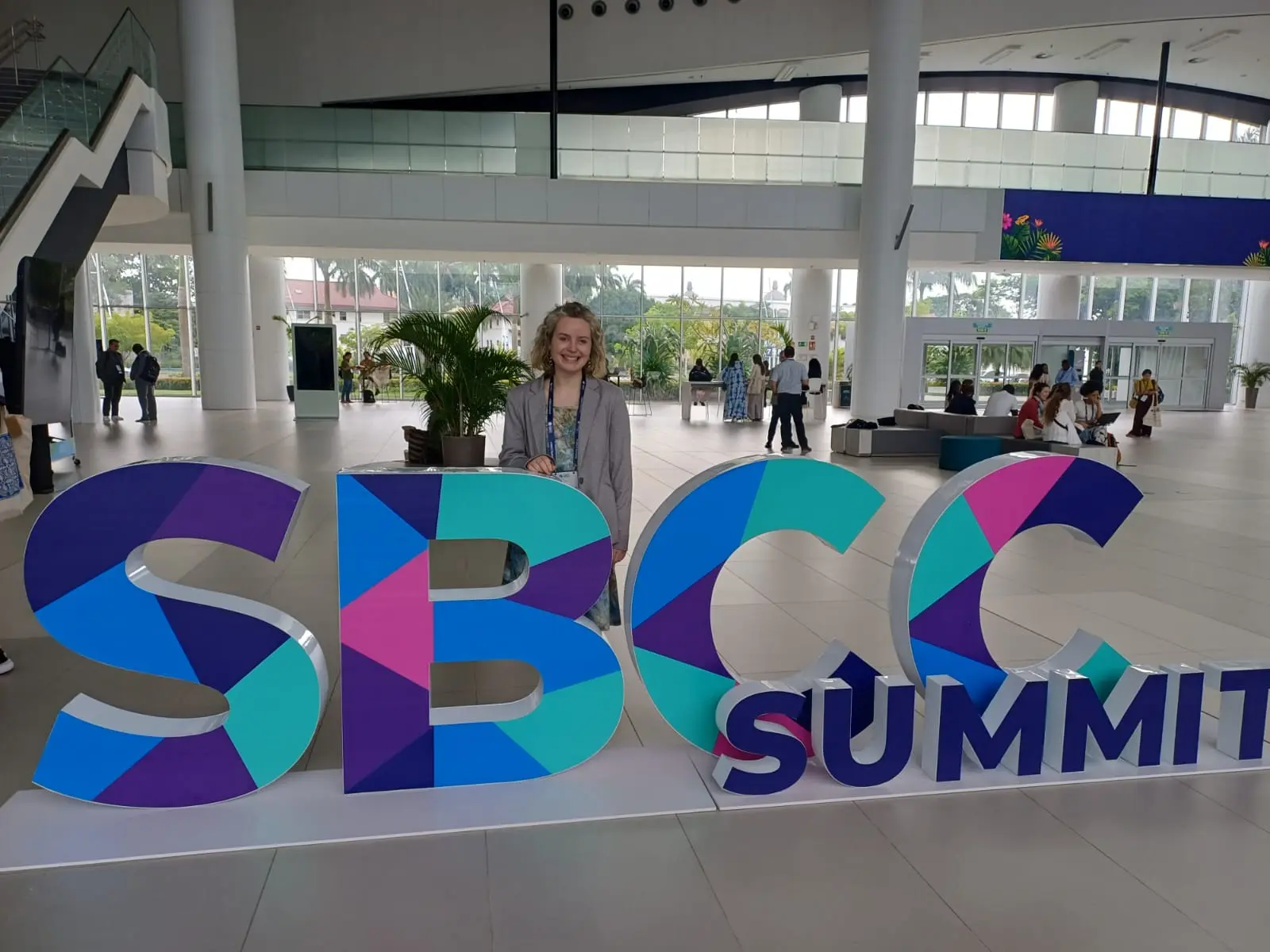
I recently joined change-makers from around the world at the International Social and Behaviour Change Communication (SBCC) Summit in Panama City.
My journey began in Casco Viejo, a historic district where the new has not erased the old but moved in beside it. Restored buildings in ochre and cream stand next to buildings that are in partial ruin, with colourful contemporary murals painted directly onto crumbling, centuries-old stone facades.
This walk through the old town established the conceptual framework for the week ahead: an exploration of legacy and innovation. I came back with a deeper understanding of how to build and innovate by drawing on past lessons and local wisdom. More importantly, I returned with a clear vision of how we can leverage these global insights at DataDrive2030 – using these lessons to make our data more compelling, inclusive, and collaborative while balancing new AI capabilities with local context.
Key Takeaways from the Summit
1. A deeper understanding and sharper definition of Social and Behaviour Change Communication
My understanding of SBC evolved from seeing it as a broad umbrella term to recognising it as a systemic discipline – the systemic use of communication to support healthier behaviours and shift the social norms that shape them. In practice, the focus now lies on two simple questions: whether people want to and are able to use a service.
Storytelling repeatedly emerged as one of the most powerful agents of change. Academic disciplines can harness this power by anchoring their advancements in local knowledge systems – marrying timeless, existing stories with the forward momentum of modern tech and AI.
This exploration of SBC helped me think about the work we do at DataDrive2030. It challenges us in how we frame our reports, interpret data in interesting ways, and increase the likelihood of action. We provide our users with accessible reports on their data, ensuring insights are understandable, contextualised, and tailored to their needs. This reinforces our aim to support stakeholders in interpreting insights through a collaborative effort that seeks to maximise impact.
2. What counts as evidence and whose knowledge gets to count?
This became a question rather than a methodological debate. It’s about understanding the many forms that knowledge takes, including the kinds that do not arrive neatly packaged in a dataset.
One standout approach involved collaborative filmmaking, where community members are trained to film and tell their own stories, then help analyse what those stories reveal in a systematic way. What resonated with me was how creative the participatory side has become.
The six-step collaborative film process – which included training, co-analysis, community screening and synthesis – uncovered richer insights using local knowledge and stories, effectively authenticating the lived experiences of communities. It fosters collaboration, reflection and agency while becoming an archival piece and foundation for future generations to tell their own stories.
I left wanting to understand how methods like this could sit alongside more quantitative measurement, rather than being treated as a softer alternative. The combination of the two would allow for both better evidence and a more credible story.
3. Embedding AI in behaviour, carefully
People are now using artificial intelligence to understand what communities care about and how quickly those sentiments shift. The conference reinforced questions about qualitative data, and how participatory methods of research can be leveraged alongside quantitative metrics in our suite of tools.
AI continues to introduce innovative approaches to measurement, moving from self-reported measurement to observed expression. For example, the MAPGEN research program combines AI language models and human collaboration to support inclusive storytelling and scalable social change. In narrative content such as films, MAPGEN uses LLM tagging to identify emotional cues and implicit social norms. This system, trained by human coders on the backend, allows researchers to decode implicit social norms and their reinforcement in media.
Advances in AI have enabled researchers to organise and analyse qualitative data more quickly and at a much larger scale, making a significant contribution to assisting workflows such as transcribing, coding, identifying data patterns and summarising themes.
However, while we can recognise its contribution, AI has clear limitations in interpreting nuances and contextualising human patterns and behaviours. The practical suggestions from the Summit emphasised keeping a human in the loop, and involving communities in validating AI-generated interpretations. The technology may be new, but its value still depends on human judgement and local knowledge.
4. Looking Ahead: Layering the New onto the Strong
The thread that tied these sessions together was not a new method but a posture: to expand and strengthen the foundations that exist.
For us at DataDrive2030, this means:
- Developing a clearer sense of what social and behaviour change work is so we can fit it into what we do already.
- Adopting a broader idea of what counts as evidence, so that community knowledge and careful measurement strengthen each other.
- Using AI mindfully so it speeds up our understanding without replacing human judgement.
All of these lessons reinforce our DataDrive2030 Strategy 2026-2030 focus of deepening local impact. We are working towards expanding our approaches to be more inclusive and collaborative, reflecting the very communities we work in.
None of this is about starting over. It is about layering the new onto the foundations that are already holding.
 The historic architecture of Casco Viejo, Panama