

Updated requirements for ELOM trainers and assessors

All ELOM assessors and trainers need to be legally compliant to work with children. From July 2024, in order to become an accredited assessor or trainer, and to maintain accreditation status, the following 3 checks are required. 1. Biometrically-verified criminal record check 2. National Register for Sex Offenders 3. National Child Protection Register This means that […]
Early Childhood Systems: Perspectives and Research Webinar Series
Together with Ilifa Labantwana, and Research on Socioeconomic Policy (RESEP) at Stellenbosch University, we are proud to present a webinar series exploring early childhood development systems within a South African context. Each month, we convene researchers, practitioners, policymakers, and partners to examine the factors shaping the effective delivery of early childhood development services – including […]
BREAKING BARRIERS: ASSESSING EARLY LEARNING IN SA’S 12TH OFFICIAL LANGUAGE

ELOM-D is the first nationally recognised and standardised early childhood development assessment tool in South African Sign Language (SASL). For the first time it will be possible to evaluate whether Deaf and hard of hearing (DHH) children are meeting age-appropriate milestones, compare them with the general population, and identify support and resources required for them […]
Updates to the ELOM Assessment Reports

Data utility is a cornerstone of our strategy. We continually strive to ensure that the data generated through the ELOM assessments are understood and appropriately used to drive change for children. Following the inaugural ELOM Users Community of Practice meeting held in May 2023, we completely revised the reporting templates used to communicate ELOM 4&5 […]
LOW DOSE LEARNING: WHAT THE DATA SAYS
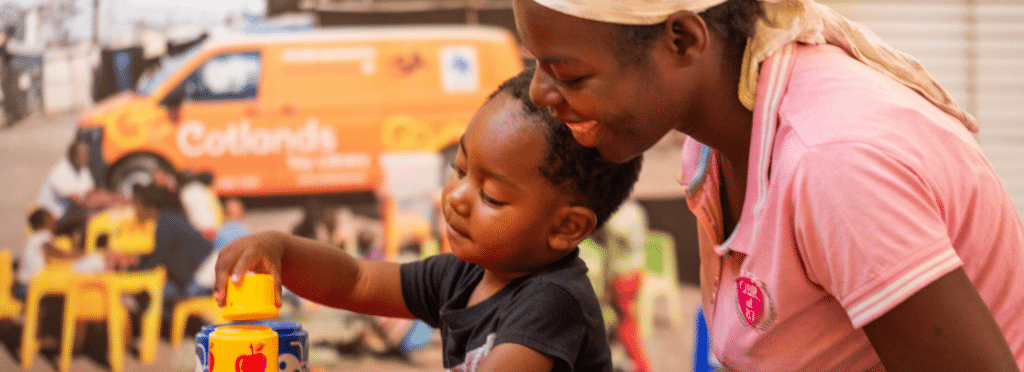
Cotlands has a rich legacy of innovation. We spoke to Cotlands’ Operations Manager Angie Bezuidenhout to find out what their ELOM data says about their innovative low-dose early learning approach and how they apply these insights to innovate and amplify their impact.
Understanding the behaviours of ECD practitioners in Positive Deviance environments

Why do some children thrive and outperform their peers despite their poorer socio-economic circumstances? DataDrive2030’s Positive Deviance Initiative (PDI) has sought to identify the factors associated with exceptional early learning outcomes for children from lower socio-economic backgrounds, whom we refer to as “positive deviants”. Our goal is to find ways to leverage these factors at […]
True North: rainbow approach to early learning

True North believes that every child can shine. Since 2007, the organisation has been instrumental in constructing a robust ECD ecosystem reaching 2,000 children across 33 early learning programmes in Vrygrond, an informal settlement in Cape Town. The organisation’s ELOM assessments, using the ELOM 4&5 Years Assessment Tool, have revealed school readiness levels on a […]
SUSTAINABLE EARLY LEARNING WITH SINGAKWENZA

Singakwenza Early Childhood Education supports informal and formal childcare facilities, parents and caregivers to make zero-cost toys from household waste. The organisation has been using the ELOM tools to measure impact and the results are remarkable, even though they primarily work in extremely poorly resourced communities. We chatted to three members of Singakwenza’s team – […]
The development of Cognitive and Executive Functioning through play

JET Education Services recently conducted research using ELOM data on the development of executive functioning, which is one of the most significant and earliest predictors of future academic success. We chatted to JET’s ECD Specialist Researcher, Rachel Neville, to discover what they’ve learned and how it can be applied in the early learning sector to give young children a better start in formal schooling.